





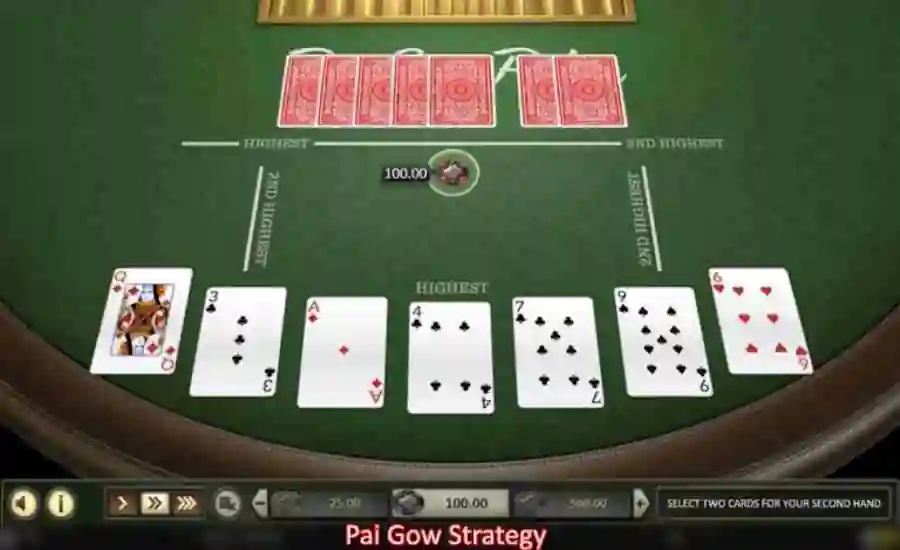
Pai Gow Poker is one of the slowest-moving and lowest-risk table games in the casino, which is exactly why many players are drawn to it. While no strategy can eliminate the house edge, smart decision-making can help you reduce losses, increase pushes, and extend your bankroll.
The casino’s house edge in Pai Gow Poker is typically around 2.3%, largely due to commission rules and the banker’s advantage. However, learning how to correctly set your hands is the most important step toward playing Pai Gow like a seasoned player.
Understanding Pai Gow Poker Basics
The Two-Hand Structure
In Pai Gow Poker, each player is dealt seven cards and must split them into:
- A five-card “back hand”
- A two-card “front hand”
The most important rule:
- The back hand must always rank higher than the front hand
- If not, the hand is fouled and automatically loses
Both hands are compared separately against the banker’s hands.
How Winning and Losing Work
- Win both hands → you win the bet (minus commission)
- Lose both hands → you lose the bet
- Win one hand and lose one hand → push
- Tie hands → ties go to the banker
Because pushes are common, Pai Gow is ideal for players who prefer low volatility over fast wins.
Core Pai Gow Strategy: Setting Your Hands Correctly
General Hand-Setting Principles
The goal in Pai Gow Poker is not to create one powerful hand, but to balance both hands so you have a chance to win both.
Key principles:
- Never sacrifice the back hand just to strengthen the front
- Avoid leaving the front hand too weak
- Aim for two competitive hands, not one dominant hand
If you’re unsure how to set your cards, many casinos allow you to copy the dealer’s house way, which is usually close to optimal.
Common Hand-Setting Scenarios
Three Pair
If you are dealt three pairs:
- Place the highest pair in the front hand
- Place the remaining two pairs in the back hand (plus the kicker)
This gives both hands reasonable strength and avoids overloading the back hand.
Full House + Two Extra Cards
A common mistake is to keep the full house intact in the back hand.
Smarter approach:
- Put three of a kind in the back hand
- Put the pair in the front hand
Why this works:
- Three of a kind beats two pair and one pair
- A pair in the front hand is far stronger than two unrelated cards
- You improve your chance of winning both hands, not just one
Four of a Kind
How you split four of a kind depends on rank:
- Low four of a kind: split into two pairs
- High four of a kind: often keep together in the back hand
Always compare expected strength, not just poker rankings.
Poker Hand Rankings in Pai Gow
Pai Gow Poker uses standard poker hand rankings:
- Straight flush
- Four of a kind
- Full house
- Flush
- Straight
- Three of a kind
- Two pair
- One pair
- High card
Remember: the back hand must outrank the front hand, regardless of how strong the front hand looks.
Banker Advantage and Commission
Why the House Has the Edge
The casino edge exists because:
- The banker wins all ties
- Winning bets are subject to a 5% commission
Some casinos offer commission-free Pai Gow Poker with modified payout rules. These versions can slightly reduce costs but may introduce other limitations.
Additional Pai Gow Tips for Better Play
Use the Dealer’s House Way
If allowed, asking the dealer to set your hand:
- Reduces mistakes
- Keeps decisions consistent
- Is especially useful for beginners
Expect Pushes, Not Big Wins
Pai Gow Poker is not designed for fast profits. Its strength lies in:
- Long sessions
- Lower bankroll swings
- Frequent pushes
This makes it ideal for players who want table time, not adrenaline.
Avoid Emotional Decisions
Because hands can look deceptively strong, players sometimes:
- Overload the back hand
- Ignore the front hand
- Foul hands accidentally
Stay disciplined and follow structure, not instinct.
Final Thoughts on Pai Gow Strategy
Pai Gow Poker rewards patience, balance, and discipline. While it won’t make you rich quickly, smart hand setting can significantly reduce losses and increase your chances of walking away even—or slightly ahead.
Focus on:
- Correct hand splits
- Avoiding fouled hands
- Accepting pushes as part of the game
Play Pai Gow Poker for longevity and control, not speed—and you’ll be playing it the right way.